Sunday, April 21, 2013

Sunday Tostadas al Gusto


Tostada al Gusto

This evening I learned the art of the simple Sunday tostada cena (dinner) from my host señora, Licha. The intent is pretty much the same as the taco/tostada dinner that I have been preparing at home for years.  It’s an informal way for everyone to help themselves and still achieve a good dose of vegetables while enjoying a selection of hardier meats and/or cheeses.  Essentially, you just peek in the refrigerator and see what’s available and go from there.
 
The crowning jewel on this night was Licha’s spectacular Chorizo Salsa.  As usual there are no exact measurements, and the limited number of ingredients is cooked quickly together.  Begin by sautéing seeded and chopped Serrano peppers in a bit of oil to soften, then add one or two chopped tomatoes, and continue until a loose salsa forms.  To this, add one or two Spanish chorizo sausages with meat removed from casings and chopped.  Cook the sauce briefly to combine flavors; season to taste with salt, and serve warm.  That’s it.

Leticia with Chorizo Salsa


Here in Querétaro, they usually don’t bother to cook up a mess of tostadas (corn tortillas).  Instead of frying an endless quantity over a hot pan, they opt for a stack of the pre-cooked packaged ones.   In Licha’s world everything has an order.  Accordingly, we begin by spreading refried beans onto the tostada and top it with a good layer of Chorizo salsa, and then a thin slice of smoked ham; add a layer of crisp shredded lettuce, a bit of chopped tomato, and finish with a few dabs of sour cream. 
 
On round two, I substituted a healthy schmear of herbed goat cheese for the beanswhich I actually preferred.  The goat cheese and Chorizo salsa were a superb combination.  We also had a variety of hot sauces on the table for everyone to add as they wished.  There was Valentine’s sauce, a robust chipotle flavored hot sauce which seems to be everywhere here; and my personal favorite, the old standby chipotles in adobo sauce. ¡Salud!


Saturday, April 13, 2013

Market Outcome


On my first weekend in Querétaro, Licha, my host señora invited me to accompany her on a weekend shop to the sprawling mercado where she has shopped for well over 20 years.  It’s the traditional type featuring stalls of specialty goods jammed tightly together―their smells blend into a visceral memory of either pleasure or disgust.    

These endearing mercados are slowly becoming squeezed out by large megastores similar to Wal-Mart and other one-stop discount outlets.  It’s tough to compete against a blinding array of conveniently packaged and processed goods at cheap prices.   However, in this city, the long-standing mercado is where the hard-core locals tend to shop.  This is a page ripped out of the history book:  valued relationships are built from frequenting the same vendors year in and year out. There is an easy flow to the rumble of conversationit’s rooted in a well-worn rhythm etched in time.  They know about each others’ families and the sense of community is clearly evident. 

Some mercados cover city blocks several stories high, with similar products allocated to particular levels.  In Querétaro, mercado Josefa Ortiz de Dominguez "La Cruz" covers much of a city block with an open air flea market guaranteed to attract even larger crowds on the weekends.  Here, Licha does a quick inspection of her favorite stalls, and then, based on the shopping list she carries in her head, she circles in on the best and cheapest offerings available.  There’s the initial banter back and forth with a discussion of her current needs, and once that is sorted out the merchant proceeds to fill her order as she stands by, watching hawkishly.   Clearly, the señora has an established reputation that she guards closely, and in doing so, she receives the very best cuts of meat and freshest produce at the cheapest price available.
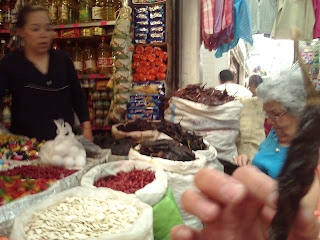
If there is one thing I have learned from Licha thus far, it’s about chilies and this señora knows her chilies.  She stops at her stall of choice and picks over heaping bags of dried pasilla, negro, and ancho chilies.  Over the course of the week these would flavor the dishes that she prepares, and what a difference they make!   

One evening we had beef in a deep chile-flavored sauce that she called guisado.  I had noticed it on many menus and wasn’t exactly sure what it was.  Turns out, it is a generic term, similar to the way we use “stew” in the US.  However, this was no bland stew; it was an elegant, well crafted affair deftly balanced by an experienced hand:  the meat a strip steak of sorts had been sliced into small pieces and gently simmered in a pre-cooked and pureed sauce simply constructed with a bit of onion, poblano pepper, dried negro, pasilla, and rojo chilies.  She tells me she’s not a big fan of refried beans, but since she offered them here, they must complement the guisado.   Homemade corn tortillas, lightly toasted on a comal, were the best utensil for mopping up every bit of the lingering sauce.  It’s the little touches, and in this case she passed peeled cucumber slices with an optional squeeze of fresh limenot traditional, but certainly the perfect fresh note for these flavors.   

Friday, March 29, 2013

Welcome to Querétaro


I will always remember the last leg of my flight into Querétaro, Mexico for the spectacular night display that played out as we blasted through the heavens. The sky was so incredibly brilliant I realized I had forgotten stars could be so dazzling. I dozed off well into Mexican territory since it was difficult to detect much below, with only long sporadic stretches of darkness.  Occasionally I’d snap to and peer out my window.   Finally, nests of twinkling clusters started sprouting up and I could see small isolated communities bound together by their shared light.

As we approached Querétaro, to my left the full moon floated above the eastern horizon; and to my right there were wide swatches of twinkling lights: nightlife so brilliant they reminded me of diamonds set into a regal crown.   It was quite the welcome. 

This morning flew; by time I had sorted myself out it was late and I was in serious need of coffee and a light breakfast.  After a failed start at my own mesón, I headed toward one of the major zocalos in search of a café.  

It was still mid-morning, but by the time I settled at a table I had abandoned the idea of a light meal altogether.  Instead I opted for Enchiladas Queretanas, a local specialty of tortillas fried until soft, then dipped into a heated chile sauce and filled with various items; mine had chopped potatoes and grated local cheese.  And the food kept coming:  a basket of fresh chips and bread, more of the warmed salsa, and a plate piled high with tropical mango, pineapple and melon.  Welcome to Querétaro!

Intermittently the server and I tried to sort out the coffee con leche issue:  first take was a cinnamon flavored pre-sweetened drink similar to coffee in the Bahamas. On a second try he brought warm milk and presented me with a jar of their best Nescafe.  One more time; I simply asked for more hot coffee to add to my flavored warmed milk.  Okay, I was difficult and still grappling with US mentality: bad gringa.   I need to get over myself and embrace the local customs.  Since he was so patient, I tipped him extravagantly. 
   
The downtown El Centro area seems be peppered with beautiful tree lined plazas; the zócalos feature a fountain with benches all surrounded by shops and cafes. Each one reflects the people who frequent it the most.  By the time I discovered the Convento de la Cruz and its plazas, I had sufficiently gorged myself enough that I passed on the incredible food these locals were offering.   

One woman had her specialty organized in a series of colorful woven bags.  A fresh stack of deep blue tortillas cooked flat and crisp first caught my eye.  In another bag, the main topping looked to be pumpkin or squash; when asked, she explained it was potatoes,colored by a red chile sauce.  It looked similar to my earlier Querétana sauce, which must be a local specialty.  I find out and get back to you on that!

Thursday, March 28, 2013

Shelf Life


The last few months have been on one wild dash with no room for blogging―and I’ve sorely missed the freedom of writing for the pure enjoyment of it.  Right now, I’m chilling at the Dallas/Fort Worth Airport on a lengthy layover and I’m thinking it’s time to blog!   

Fact is, I’m heading to Querétaro, Mexico for one final term of intensive Spanish Language in an immersion program, and while there I hope to post a few blogs on the food and culture of the area.Querétaro is a colonial city between Guadalajara and Mexico City, surrounded by history and plenty to see and do.  But, more on that later.  

Right now I want to share a little on one of my recent projects: one that proved far more provocative that I anticipated.  It’s difficult to get too worked up about a course in Library Science but this one was a surprise.  I worked with the library staff at the University of Oregon to create an independent studies course related to cookbook collections: what makes a good one, and the various forms that they can take.  The real attention grabber was the development currently taking place in online digital collections―thanks to technologically innovative college and university libraries.  

Often rare monographs, texts, and documents are tucked away in “dusty archives” that are not widely known to the general public.  Now, with the advent of online technology, digitizing these one-of-a-kind collections is making them accessible for everyone.   If you are into food history or read cookbooks, here are a few collections worth knowing about.


Indiana/Purdue University provides a small but well represented collection: Service Through Sponge Cake.  This helpful project is a good way to begin exploring online collections.   About 67 searchable community cookbooks and menus are easy to explore, with plenty of helpful links and curatorial information.


It’s not a surprise that Cornell University, home of the noted School of Hotel Administration would offer an outstanding site.  It takes tons of man hours and technical expertise to organize an undertaking of this magnitude.  Currently featured, Not by Bread Alone is one of several searchable collections worth checking out not only for  historical significance, but for charming graphics and solid background material.

Another project worth knowing about is the collection at the University of Texas, Austin presenting  the Knopf Archives:  Julia Child’s “the Proper Binge” Collection, which features correspondence, photos, and such between the publishers and Julia Child during the writing of Mastering the Art of French Cooking. 


Michigan State University’s Feeding America, projects and cookbook collections showcase well over 10,000 cookbooks and Americana food/cookery publications destined to become even more impressive over time.  Because of its size, it can be cumbersome. Don’t miss the amazing collection, Little Cookbooks: Alan and Shirley Brocker Collection.  Also featured, many museum objects can be explored with interface maneuverability; excellent descriptive and curatorial documentation is provided. 


As libraries look for creative ways to stretch their dollars and consider how to draw in a new audience of savvy technology oriented readers, digital collections are surely to become more and more mainstream.   Digital collections make sense in wooing a younger audience: a move toward expanding their reach beyond the hallowed halls.  But it is not likely that books will disappear off the library shelves altogether, for who loves books more than librarians?  However, pragmatists recognize that the world is changing: libraries must adapt to new needs and they are surely becoming more selective in what they purchase and how it is presented.


LinkWithin

Related Posts with Thumbnails